
Risk Aversion
Investors have little appetite for climate projects in developing countries, given the uncertainties: political risk, a difficult business environment, and adverse currency movements.
The Challenge
Climate catastrophe is one of the most imminent threats we face. The countries least responsible for it are the ones most exposed, and they have the least money to respond.
An imminent threat
The evidence points to a grim future. Under "business as usual," the planet is on track to warm 2.7 degrees Celsius. Climate scientist Kevin Anderson has said a world roughly 3 degrees warmer is not compatible with organized human civilization. Rising seas, mass species extinction, 1.5 billion people displaced, and the risk of Multiple Breadbasket Failures all point to disruption of the world's food supply. The damage will reach every part of the globe, but some nations will be hit far harder than others.
That burden is not shared evenly. The regions and people already held back by development constraints are the most exposed to climate hazards. Vulnerability runs highest where there is poverty, weak governance, limited access to basic services, violent conflict, and a heavy reliance on climate-sensitive livelihoods such as smallholder farming, pastoralism, and fishing. The latest IPCC report found that over the last decade, human mortality from floods, droughts, and storms was 15 times higher in highly vulnerable regions than in regions with very low vulnerability.
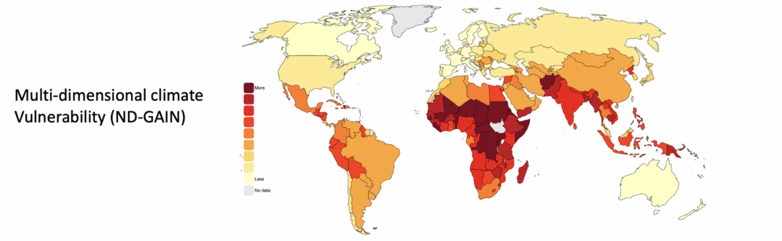
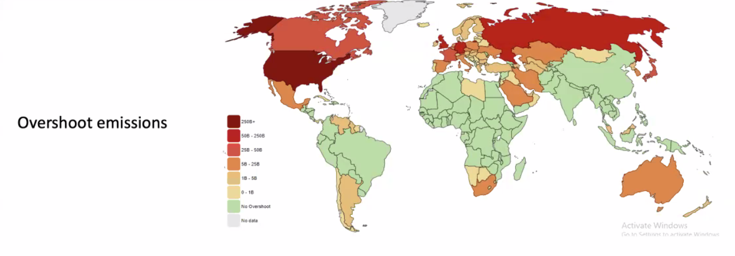
The IPCC report shows that today's high vulnerability is shaped by historical and ongoing patterns of inequity. Responsibility for the crisis does not sit with the countries suffering most. Most of the global south remains well below its overshoot limit.
Broken commitments
The global financial industry has been one of the biggest contributors to climate breakdown, and it keeps funding fossil fuels. Transparency and follow-through on commitments have been thin. According to "Banking on Climate Chaos 2021", the 60 largest commercial and investment banks poured USD 3.8 trillion into fossil fuels from 2016-2020, despite the Paris Agreement. Banks and companies have made net-zero pledges, but they tend to come with loopholes, no way to enforce them, and little transparency.
The pledges from developed countries to developing ones have fallen short too. In 2009, wealthy nations agreed to raise USD 100 billion per year by 2020 to help highly vulnerable countries face climate disaster. Climate finance was rising before the pandemic, but it has never reached that USD 100 billion-a-year target. Policymakers and international bodies need to hold these commitments together with real accountability metrics.
The UN Environment Programme (UNEP) estimates that adaptation alone will cost developing nations roughly USD 300 billion per year by 2030, rising to USD 500 billion a year by 2050. Add mitigation, and the total passes USD 1 trillion.
Investors have little appetite for climate projects in developing countries, given the uncertainties: political risk, a difficult business environment, and adverse currency movements.
Private green finance keeps hitting the same wall: investable climate projects in developing countries are hard to find.
Unwelcoming and unpredictable regulation scares money away, and weak communication between financial institutions, governments, and regulators makes it worse.
Many institutions simply lack the tools to analyse environmental risks and put numbers on a project's environmental benefits and costs.
Most financing goes to cutting emissions rather than adapting to what's already coming. Skipping adaptation now means much higher costs later.
Roughly 47% of global climate finance reaches developing-country projects, and most of that goes to China, India, and Brazil. Middle- and low-income countries are left exposed (Climate Policy Initiative).
The supply side
Finance can do a lot to fight climate disaster. It can channel the money the green transition needs and make funding easier to get for green projects. It can also push the whole market toward greener choices through pricing: building climate factors into the cost of capital, rewarding companies that take on green projects with lower lending rates, and raising the cost of funds for "brown", highly polluting industries.
The demand side
It's time to scale up financing for investments with environmental benefits, using new instruments and policies: green bonds, green banks, carbon market instruments, green central banking, fintech, and community-based green funds. But with limited R&D and restricted access to technical know-how, developing countries struggle to build pipelines of bankable green projects that can absorb the climate finance already pledged. ICFC provides the technical assistance and support to close that gap.
The imperative
Getting to a zero-carbon, resilient economy takes collaboration across sectors and borders, real accountability, and new ideas. Greening the financial services industry and building capacity across the developing world is how we hit the 1.5 degrees Celsius target.